Pharmacy: Patient relations vs. customer relations, best practices
The patient base refers to all the people who regularly visit the same pharmacy for their medications and health advice. The term is modeled after “clientele,” but it is not the same: it implies a healthcare relationship, governed by professional obligations, whereas “clientele” refers to a commercial relationship. This distinction, often treated as merely a matter of vocabulary, actually reflects two distinct ways of conceiving the role of the pharmacist behind the counter.
The role of the pharmacist has long been misunderstood and is sometimes confused with that of a retailer. Yet the pharmacist’s primary role is that of a community healthcare professional who provides advice and ensures follow-up care. This article explains what distinguishes the patient-pharmacist relationship from the customer-pharmacist relationship, what the two approaches have in common, and how to reconcile them in practice.
Patients and customers: What's the difference?
Both terms describe the same accounting concept: a group of people who frequent the same establishment. They differ in terms of what forms the basis of the relationship.
Customer choice is based on free and reversible decision-making. Customers compare options, weigh their choices, and switch providers without any consequences. The relationship is symmetrical: either party can terminate it.
The patient-pharmacist relationship is based on a care relationship. Patients do not choose their own treatment; they cannot always assess its appropriateness; and a breakdown in this relationship can have consequences for their health. Pharmacists are bound by obligations that do not apply to any other retailer: the duty to provide advice, the obligation to refuse to dispense medication in certain situations, and professional confidentiality.
In a pharmacy, both aspects coexist. A single visit to the counter can involve both filling a prescription and purchasing an over-the-counter product. The question, therefore, is not a matter of choosing one term over the other, but of determining which one applies in each situation.
Convergence and divergence between patient and customer relationships
The patient-provider relationship and the customer-provider relationship share real similarities, but also fundamental differences.
What they have in common is a shared goal: meeting a need by providing quality service. In both cases, it is essential to listen to the customer’s needs, understand them, and provide an appropriate response. In both cases, communication is key: building trust, providing clear information, and answering questions accurately.
The difference between them lies in the nature of the service provided. The customer relationship aims to meet a need expressed through a transaction. The patient relationship aims to provide ongoing support for a health condition, which involves follow-up, monitoring the progress of treatment, and taking into account the entire course of care.
The emotional aspect is also different. A patient may feel vulnerable, anxious, or confused about their illness or treatment. This situation calls for an approach that has no equivalent in a business transaction.
Taking the best of both approaches
The two approaches are not mutually exclusive. Certain practices drawn from customer relations directly improve the patient experience without compromising the quality of care.
The way staff greet and assist customers at the counter, manage wait times, provide clear information, and follow up between visits are all part of a set of best practices that the retail sector established long before the healthcare professions did. Incorporating these practices does not turn patients into customers; rather, it makes the care relationship clearer and more accessible.
Conversely, the rigor inherent in the patient-care relationship—including traceability, verification, and documentation of what was said and done—also benefits the pharmacy’s commercial activities.
Claiming the pharmacist's place in the care network
Community pharmacists play a unique role in the continuum of care: they are the most accessible healthcare professionals—no appointment needed—and are often the ones seen most frequently by patients with chronic conditions.
This role serves as a foundation for the responsibilities that have gradually been entrusted to the pharmacist, including medication counseling, shared medication reviews, and support for medication adherence. It requires that the role be recognized and championed, including by the patients themselves.
An exclusive OpinionWay survey for Medissimo and Notre Temps, conducted in June 2023 among 630 seniors taking multiple medications, sheds light on this issue. First and foremost, 46 percent of patients view the pharmacist as the person who dispenses medications. Just over a third—35 percent—consider the pharmacist a healthcare partner who provides advice. Twenty-six percent view the pharmacist as a point of contact with whom they can discuss their health. Only 8 percent see the pharmacist as someone who actively supports proper medication use.
There is therefore a wide gap between what pharmacists do and what patients perceive. However, the same study shows a high level of openness: 54 percent of older adults taking multiple medications say they are willing to share information about their adherence with their pharmacist, and 22 percent explicitly want their pharmacist to be more involved in monitoring their treatment.
This trend is even more pronounced among patients with the poorest adherence and in less densely populated urban areas. This suggests thatproviding support to older patients at the pharmacy is more feasible than daily practice sometimes suggests.
Reconciling profitability and core missions
The conflict between profitability and the mission to provide healthcare is less clear-cut than it seems, as long as the services provided are recognized as such by the patient.
On this point, the study provides data that can be put to immediate use: 18 percent of older adults taking multiple medications say they are interested in having their pill organizers prepared at a pharmacy, and among them, 78 percent are willing to pay for this service. This interest rate doubles to 35 percent among patients with poor medication adherence.
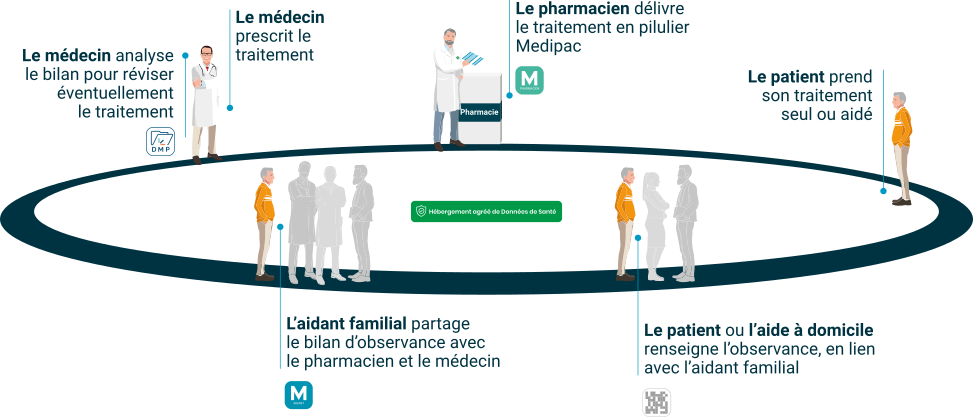
Preparing doses for administration, conducting medication reviews, and providing support for medication adherence are billable services that are an integral part of patient care. They do not replace medication dispensing; rather, they extend it.
This approach aligns with that of medication reviews and adherence: what improves patient care also creates value for the pharmacy, provided it is organized and billed as a standalone service.
In summary
In the day-to-day practice of a pharmacy, the relationships with patients and customers are not mutually exclusive; they overlap. What distinguishes the two relationships is not the quality of the welcome or the attention given to the individual, but rather the professional framework that applies whenever treatment is involved.
Practices drawn from customer service can strengthen the therapeutic relationship. They do not replace it.
Source of the figures: an exclusive OpinionWay survey for Medissimo and Notre Temps, conducted from June 2 to 12, 2023, among 630 people aged 60 and older who have been taking at least five medications a day for at least six months and are digitally independent.