
Visit medication review is an analysis report dedicated to medication. The aim of this interoperable medium is to share information between the various healthcare professionals involved in the patient's care, in order to ensure safe medication management.
Drug information includes the patient's therapeutic profile, detailed list of treatments, therapeutic compliance and side effects.
This medication review is used in particular for shared medication reviews in towns and cities, and as part of medication conciliation in hospitals for patients with chronic diseases who are polymedicated (taking at least 5 medications at the same time).
This shared assessment aims to improve the safety and efficacy of treatments, while simplifying the organization of care.
Here are the main numerical steps in a medication review:
Medication reconciliation is a key concept in patient safety and drug therapy optimization. It is a process by which all medications taken by a patient are reassessed to ensure their appropriateness, efficacy and safety. In this article, we'll explore in detail what medication review is, why it's essential, and how it's implemented in healthcare.
Medication review is a collaborative process involving several healthcare professionals, including the attending physician, pharmacist, nurse and sometimes other specialists. The aim is to carefully study the medications a patient is taking, including prescription treatments, over-the-counter drugs and even dietary supplements.
a) Definition and objectives
The aim of the medication review is to identify medication risks and treatment redundancies, and to ensure that all medications are appropriate for the patient's current state of health. In addition, it seeks to improve patient adherence to the prescribed treatment, by clarifying how to take it and addressing any difficulties.
b) Who is concerned by the medication review?
All patients taking multiple medications or presenting specific risks (such as the elderly or those with chronic illnesses) are good candidates for a medication review. It is particularly useful for polymedicated patients, i.e. those taking five or more medications on a daily basis.
Medication reconciliation is essential for a number of reasons relating to patient safety and the quality of medical care.
a) Reducing medication errors
Medication errors can have serious consequences. The wrong dosage, a harmful interaction between two substances, or taking a drug that is not suited to a particular health condition can all lead to side effects. A medication review can detect and correct these errors.
b) Improving treatment efficacy
Reviewing prescriptions helps to ensure that each drug is effective for the condition being treated, and that the patient's condition still justifies its use. For example, a drug prescribed for an acute illness may no longer be necessary once it has been cured.
c) Increased therapeutic adherence
The complexity of treatment is often a barrier for patients. A well-administered medication review can simplify intake protocols, reduce the number of medications or adjust schedules to make treatment easier to follow.
Medication assessment follows a well-structured procedure to maximize its effectiveness.
a) Information gathering
The first step is to gather detailed information on all medications taken by the patient, including recent prescriptions, over-the-counter drugs, as well as natural health products or dietary supplements.
b) Treatment evaluation
Doctors then review this information, ensuring that each drug is necessary, effective and without risk of interaction with other substances. This step includes reassessing the appropriateness of each treatment based on the patient's new clinical data.
c) Adapting treatment
Following the assessment, recommendations may be made to adapt the treatment, whether by modifying the dosage, changing the medication or discontinuing a treatment that has become unnecessary. This stage is carried out in consultation with the patient, to ensure their involvement and understanding.
Medication reconciliation offers a number of advantages for both patients and healthcare professionals.
a) More personalized care
By taking into account the patient's entire medical context, including other treatments and general condition, professionals can propose a more appropriate medication strategy.
b) Reducing hospitalization
Better management of medication regimens reduces the risk of serious complications linked to medication misuse, which in turn can lead to fewer unnecessary hospitalizations or emergency room visits.
c) Optimizing the cost of care
By eliminating redundant or inappropriate medications, medication reconciliation helps reduce costs for patients and the healthcare system.
Pharmacists play a central role in medication assessment. As drug experts, they are often the first port of call when it comes to assessing patient compliance with treatment, and detecting interactions or risks.
a) The relationship of trust between pharmacist and patient
Pharmacists are often more accessible than GPs, and this proximity helps build a relationship of trust with patients. This encourages open communication about taking habits and any problems encountered.
b) Bringing in additional expertise
Thanks to their specific knowledge, pharmacists can provide practical advice and therapeutic adjustments, while coordinating their actions with those of the attending physician to ensure coherent overall care.
The elderly are particularly vulnerable to medication errors, due to their multi-medication and susceptibility to drug interactions.
a) Polymedication and frailty
As patients age, they often take more medications to treat multiple chronic conditions. This increases the risk of adverse reactions, dosage confusion and harmful interactions. Medication assessment is therefore crucial to adapting treatments to the changing needs of elderly patients.
b) Screening for side effects
In the elderly, some side effects may be mistaken for symptoms of aging. Medication assessment helps to identify whether disorders such as dizziness, confusion or falls are drug-related, and allows treatments to be adjusted accordingly.
Despite its many advantages, the implementation of a medication review can be fraught with obstacles.
a) Cooperation between healthcare professionals
Communication between the various healthcare professionals involved can be a challenge. Effective collaboration channels need to be created to share accurate, up-to-date treatment information.
b) Time and resources
Medication review is a time-consuming process. It can be perceived as a time-consuming task, especially in contexts where healthcare professionals are already overburdened.
With the evolution of health technologies, medication assessment could become even easier and more precise.
a) Digital tools and artificial intelligence
Software and artificial intelligence tools could be used to automate data collection and workflow management. These digital solutions would facilitate more systematic, real-time medication reviews.
b) Developing new professional practices
Training healthcare professionals in the importance of medication reviews could become widespread. This would encourage a more proactive approach to medication management, and further improve the quality of care offered to patients.
Medication reconciliation is becoming an essential tool in the arsenal of healthcare professionals for optimizing patient medication management. This collaborative approach between pharmacists, doctors and patients not only improves the safety and efficacy of treatments, but also reinforces patient compliance.
By focusing on a global, personalized analysis of treatments, medication reviews help reduce the risk of adverse effects, drug interactions and avoidable hospitalizations. It thus represents an important step towards more precise, patient-centred medicine.
Despite the challenges associated with its implementation, particularly in terms of cooperation and resources, medication reconciliation is establishing itself as an essential practice for improving the quality of care, especially for patients with polymedication or chronic illnesses. With the advent of new technologies and the evolution of professional practices, we can expect this approach to become even more widespread and refined in the years to come, contributing to better public health and a more judicious use of medical resources.



Recommended when organizing shared medication baskets (sachets, liquids, etc.)
| Patients | Mono28 | Medipac | Medipac plus |
| M2 | 25 | 64 | 24 |
| M3 | 45 | 96 | 48 |
| M4 | 65 | 128 | 72 |

Recommended for organizations with no drug storage area (all drugs in the cart for 7 days)
| For 14 patients |
| For 28 patients |

Recommended for use with nominative lockers (dose and non-dose drugs together)
| Patients | Monoplus for 1 or 2 days | Dose sachet for 7 days |
| M2 | 36 | 48 |
| M3 | 48 | 72 |
| M4 | 60 | 96 |

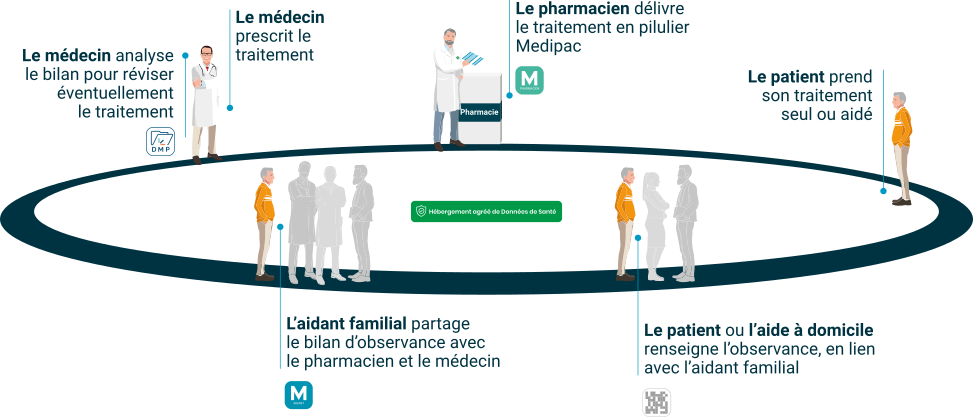
The Medipac solution offers you the safety and convenience of a pharmacy-prepared, ready-to-use treatment. This solution helps you take your medication properly, which in turn helps your doctor adjust your treatment for better long-term health results. With this solution, you'll improve your compliance to protect your health.
The Medipac solution includes a secure pill dispenser connected to the pharmacy application by a QR code. The solution can integrate an application for caregivers. The data is fed into a compliance report for discussion with the pharmacist and review of treatment with the doctor. Use is free of charge.

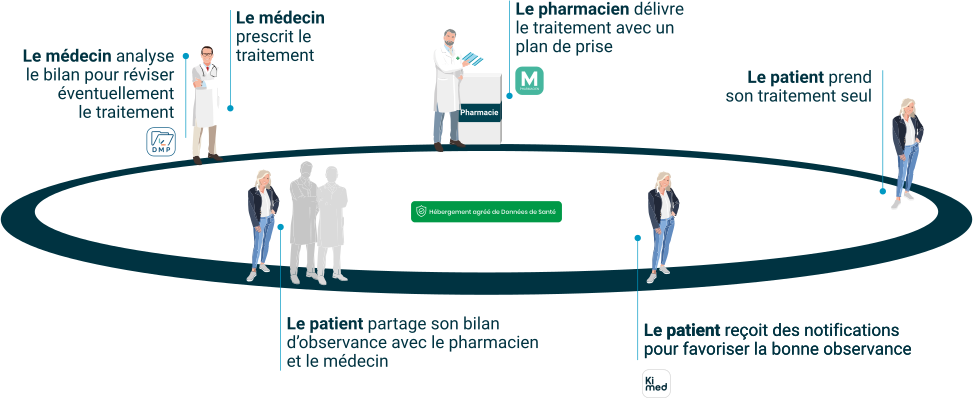
The Kimed solution helps you to take your medication properly, which in turn enables your doctor to adjust your treatment for better long-term health results. With this solution, you'll improve your compliance to protect your quality of life.
The Kimed solution connects a patient application to a pharmacy application. The patient receives notifications to prevent forgetfulness and provide information on compliance, side effects and additional medication taken. The data is fed into a compliance report, which can be discussed with the pharmacist and the treatment reviewed with the doctor. Use is free of charge.
This detachable pill dispenser allows you to repackage medications by dose, but separately, for one week. Ideal for storage in nominative compartments.
MULTIPLUS® packs all your medications in a single dose for one week. The MULTIPLUS® pill dispenser is useful for institutional use when the original blister pack needs to be preserved, and the individual drugs do not need to be isolated from each other.
This non-detachable pill dispenser allows you to repackage medications by time of use, for one month. Ideal for frequent medication changes.
The compliance report is a summary table of medication taken, enabling treatments to be re-evaluated from the Pharmacist App and the Establishment App.
The assessment is available for each patient on the nursing and pharmacy applications.
The assessment provides a global and detailed view of compliance, and helps to better understand the reasons for non-administration at any given time. The physician's analysis of the assessment enables him/her to take action to encourage proper use of the medication.
The "bilan de bon usage" is a set of summary tables used to identify at-risk patients and drugs from the Medissimo Pharmacien app.
The balance sheet is available to the establishment on the pharmacy application.
The assessment provides an overall view of the risks associated with medication at any given time. The physician's analysis of the assessment enables him/her to take action to promote the proper use of medication.
The MEDISSIMO platform offers a secure, traceable treatment service for patients at home and in residential care, including pillboxing of medicines in the pharmacy and treatment monitoring in cooperation with healthcare professionals and their families.
The platform brings together the pharmacist, who delivers the treatment with full traceability, and the patient or his or her homecare assistant, who fills in the dosages from the MEDIPAC® pillbox prepared by a healthcare professional, and the nurse, who monitors the treatment in liaison with the pharmacist and the family, and informs the doctor in the event of a medication risk.
In line with the public health priority defined in the national health strategy, the pharmacist - nurse - attending physician triad is at the heart of the platform designed by MEDISSIMO, with the aim of promoting the proper use of medicines.
