Poor medication adherence is often portrayed as a behavioral issue, or even a matter of patient motivation. The available data reveal a more complex reality: the medication itself, its form, its packaging, and its readability are measurable barriers, just as much as forgetfulness or the perception of risk.
This article is based on an exclusive OpinionWay survey conducted for Medissimo and Notre Temps in June 2023 among 630 people aged 60 and older who take at least five medications a day.
What "poor adherence" Encompasses
Adherence refers to the degree to which actual medication use aligns with the prescription. Discussing poor adherence without specifying the nature of the discrepancy leads to inappropriate responses, since the behaviors grouped under this term do not share the same causes or solutions.
The study distinguishes between them and measures them separately among older adults taking multiple medications.
Forgetting to take medication affects 65 percent of respondents, who report having missed a dose at some point. This is the most common issue, and the one where measures to prevent missed doses have the most direct impact.
The delay affects 28 percent of respondents, who report that they have already taken their medications at a different time.
Changes to or discontinuation of doses have affected 13 percent of patients over the past few weeks.
Reasons for not taking medication include 18 percent who cite a specific side effect they experienced, and 10 percent who believe that a medication does them more harm than good.
The supply disruption affects 10 percent of patients, who have run out of medication since their last visit.
An oversight is an organizational issue. A deliberate discontinuation is a decision made by the patient, often related to an adverse effect, and requires a reassessment of the treatment. A supply shortage is a logistics issue. These three situations do not call for the same response.
The Gap Between Self-Reported Adherence and Actual Adherence
When asked directly, the vast majority of older adults taking multiple medications believe they manage their treatments well: 82 percent say they follow their doctor’s orders very well, and 93 percent report having little or no difficulty taking their medications.
Based on an assessment using six behavioral questions, the reality is different. Only 32 percent demonstrate good adherence. Average adherence is observed in 56 percent of respondents, while poor adherence is observed in 12 percent—representing approximately 200,000 to 220,000 people relative to the reference population.
This discrepancy is the starting point for any action. A patient who does not perceive himself or herself as being in trouble will not spontaneously report these discrepancies and will not ask for help.
The drug itself as a deterrent
This is the aspect that is most often overlooked. Yet it is the one on which healthcare professionals can have the most direct impact.
The way the medication is dispensed is a barrier to adherence for 30 percent of older adults taking multiple medications, who experience at least one of the following difficulties.
| Difficulty | Together | Good compliance | Poor adherence |
|---|---|---|---|
| Handling or opening the packaging | 15 % | 5 % | 31 % |
| Swallow the tablets or capsules | 15 % | 6 % | 26 % |
| Strong or unpleasant taste | 14 % | 5 % | 38 % |
| Distinguishing Between Different Medications | 11 % | 4 % | 27 % |
| At least one of these reasons | 30 % | 12 % | 56 % |
The difference between the groups is significant. More than one in two patients with poor adherence report at least one difficulty related to the dosage form or packaging, compared with one in eight among those with good adherence.
Taste is the most significant distinguishing factor: 38 percent among patients with poor compliance, compared with 5 percent among those with good compliance.
These difficulties aren't apparent at the reception desk, and patients rarely mention them on their own. They can be identified by asking the right questions.
Physical and Cognitive Challenges
A second set of barriers relates to the patient’s condition. It affects 18 percent of older adults taking multiple medications, but 50 percent of those who do not adhere to their treatment regimen.
| Disorder | Together | Poor adherence |
|---|---|---|
| Numbness in the fingers or hands | 7 % | 18 % |
| Dry mouth making it difficult to swallow | 7 % | 20 % |
| Deformities of the hands or fingers | 6 % | 14 % |
| Memory Issues | 5 % | 18 % |
| Vision problems that make it difficult to distinguish between medications | 3 % | 11 % |
| Tremors interfering with the grip | 2 % | 7 % |
These figures pertain to independent seniors living at home who are digitally literate, which explains the relatively low overall levels. When compared to the subgroup with poor adherence, the figures take on a different scale.
Dry mouth and numbness—symptoms rarely mentioned in discussions about adherence—are among the most common.
The Nature of the Treatment
The burden of treatment remains the same regardless of the form of the medication.
The older adults surveyed who are on multiple medications take an average of 6.7 different medications and 8.4 tablets or capsules per day, divided into 2.6 doses. They themselves feel that taking more than seven medications a day makes the regimen too burdensome.
Nearly four in ten—or 39 percent—have prescriptions from multiple doctors. Of these, 20 percent have three prescriptions, and 8 percent have at least four. As a result, no single prescriber necessarily has a complete picture of the patient’s treatment.
In addition, 62 percent take over-the-counter medications in addition to their prescription medications, a proportion that rises to 68 percent among those taking at least seven medications a day. These medications are not tracked by either the patient or the healthcare professional.
The nature of the condition also plays a role. Long-term treatment for a chronic condition becomes part of a routine, which helps ensure consistency. Symptomatic treatment is more often discontinued as soon as the symptom disappears, without the patient perceiving this interruption as a deviation from the norm.
What the Patient Thinks
Risk perception is the least visible factor—and probably the most decisive one.
24 percent of older adults taking multiple medications believe that it is not a big deal to forget to take their medications from time to time. Among patients with poor adherence, this proportion rises to 38 percent.
Even more striking is that 79 percent believe that taking at least one out of every two doses constitutes proper adherence to treatment. This proportion rises to 98 percent among patients with poor adherence.
In addition, 28 percent believe that there are medications for which the dose can be safely reduced, and 26 percent believe that there are medications that can be safely discontinued.
These beliefs are not based on negligence. They are grounded in real-world experience: an isolated lapse generally has no noticeable effect. It is repetition that matters, and that is not perceptible on a daily basis.
Profile of the patients involved
The study describes the 12 percent who do not adhere to treatment, and its findings contradict several common misconceptions.
They are more often women, at 53 percent. On average, they are younger than the overall group of seniors taking multiple medications surveyed, at 68.2 years old. They are more likely to belong to the least advantaged socioeconomic groups. Fifty percent live alone, and 28 percent are divorced.
They feel, almost unanimously—88 percent—that they have too many medications to take, while also taking comfort medications more often than average—76 percent versus 62 percent.
Isolation and feelings of being overwhelmed therefore stand out more than advanced age. Conversely, good adherence is more common among older seniors who live with a partner and receive assistance.
A fact to take seriously: a pill organizer alone isn't enough
On this point, the study provides data that deserves to be taken seriously.
54 percent of older adults taking multiple medications use a pill organizer. This proportion is 54 percent among patients with good adherence, 55 percent among those with moderate adherence, and 54 percent among those with poor adherence.
In other words, the use of a pill organizer does not distinguish between the three groups. The container alone does not improve adherence.
What the figure suggests is that the difference does not lie in whether a pill organizer is used, but in how it is filled, updated, and monitored. A pill organizer filled by the patient themselves replicates the patient’s own misunderstandings, is not updated when a prescription changes, and does not generate any information that a healthcare professional can use.
Furthermore, barely 7 percent of older adults taking multiple medications have a medication reminder system. This proportion rises to only 11 percent among those taking at least nine pills a day—that is, among the patients at highest risk.
Areas for Action
Adjust the dosage form. This is the most direct approach, given the data on pharmaceutical formulation. Difficulty swallowing, an unpleasant taste, or packaging that is hard to open can sometimes be resolved by choosing an alternative treatment or modifying the packaging. However, the problem must first be identified.
Simplify the dosing regimen. Group doses together, limit the number of times medication is taken throughout the day, and reevaluate treatments whose benefits are no longer established. This is the prescriber’s responsibility, but the pharmacist is well-positioned to highlight the need for it.
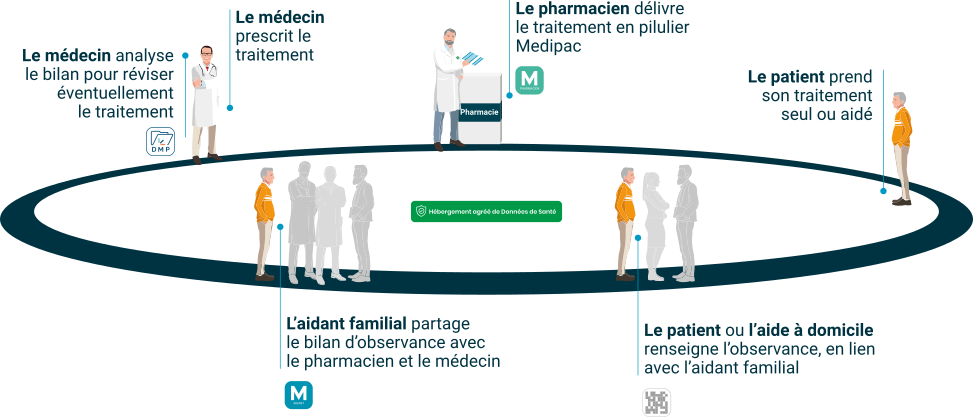
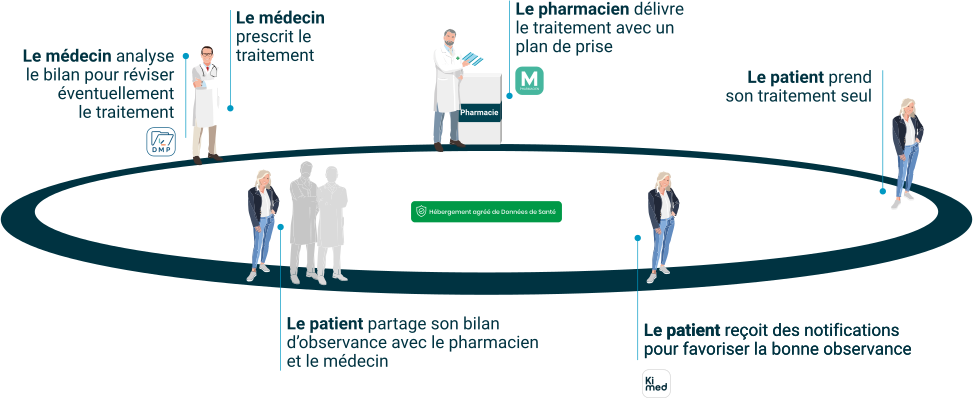
Ensuring the safety of medication preparation. Preparing a pill organizer at a pharmacy provides what the pill organizer alone cannot: compliance with the current prescription, removal of discontinued treatments, appropriate labeling, and a regular point of contact. These discrepancies are particularly common in the management of at-home treatments, where the administration process is fragmented among multiple parties.
Implement a follow-up system. The 7 percent equipment rate leaves considerable leeway, particularly for patients undergoing the most intensive treatment.
Addressing the issue of perception. A patient who is convinced that taking one dose out of every two is enough will not change their behavior simply because they have been given a better tool. This requires explanation, not equipment.
The role of the pharmacist
The study highlights a resource that is still underutilized in practice.
54 percent of older adults taking multiple medications say they are willing to share information about their medication adherence with their pharmacist. This proportion rises to 62 percent among patients with poor adherence—that is, precisely those for whom the stakes are highest.
22 percent explicitly want their pharmacist to be more involved in monitoring their treatment, and 48 percent are not opposed to this. 18 percent say they are interested in having their pill organizers prepared at the pharmacy, and 78 percent of them are willing to pay for this service. Among patients with poor adherence, interest in having pill organizers prepared at the pharmacy reaches 35 percent.
These expectations are more pronounced in less densely populated urban areas.
However, only 8 percent of respondents view pharmacists as actively supporting proper medication use. The gap between this role and this perception is, in itself, a lever that the shared medication review makes it possible to leverage within a contracted framework.
Frequently Asked Questions
What is poor medication adherence?
It refers to a discrepancy between actual medication use and the prescription. This discrepancy encompasses various behaviors: missed doses, delayed doses, deliberate discontinuation, dose adjustments, and running out of medication. Each requires a different response.
Does poor adherence depend on the type of medication?
Partly. The way the medication is presented is a barrier for 30 percent of older adults taking multiple medications and for 56 percent of those who do not adhere to their treatment regimen. Difficulties swallowing, opening the packaging, or an unpleasant taste are measurable causes distinct from simply forgetting to take the medication.
Does poor adherence increase with age?
Not necessarily. According to the study, good adherence is more common among the oldest seniors who live with a partner and receive assistance. Patients with poor adherence are, on average, younger—68.2 years old—and live alone in half of the cases. Isolation has a greater impact than age.
Does a pill organizer improve adherence?
Not on its own. The study notes that 54 percent of older adults taking multiple medications use a pill organizer, with an identical proportion across the three adherence profiles. What makes the difference is how the pill organizer is prepared, updated, and monitored.
How can you identify a patient in distress?
Self-reported data are unreliable: 82 percent of seniors claim to adhere very well to their prescriptions, while only 32 percent actually demonstrate good adherence. Useful indicators are indirect: delayed refills, large remaining stock, or a passing mention of difficulty with the packaging or taste.
Source of statistical data: an exclusive OpinionWay survey for Medissimo and Notre Temps, conducted from June 2 to 12, 2023, among 630 people aged 60 and older who have been taking at least five medications a day for at least six months and are digitally independent. Confidence intervals range from 1.7 to 4 points, depending on the percentage measured.