Are you a pharmacist? Watch the Medissimo Pharmacist video. Doctors, pharmacists, nurses: easily share medication reviews
Palliative care

Pillboxes and the management of palliative care patients

Medication management for palliative care patients is a complex and sensitive task. The medication management process in home-based palliative care: coordination and limitations of the pill organizer

Home-based palliative care relies on a medication management system that differs significantly from that used for stable chronic patients. Treatment changes rapidly, involves combinations of medications that a pill organizer cannot accommodate, and simultaneously involves multiple care providers who do not interact with one another. Understanding the role of the pill organizer in this context first requires identifying what it does not cover.

What Sets the End-of-Life Home Care Program Apart

For a stable, long-term patient, the prescription changes very little. Weekly preparation, dispensing, and follow-up are organized on a predictable schedule.

During the palliative care phase, three factors disrupt this structure.

Treatment is constantly evolving. Adjustments are made based on changes in symptoms and the patient's response. A prescription may be changed several times in a single week, and sometimes even in a single day.

The treatment combines several routes of administration. Oral formulations are frequently supplemented by injectable, transdermal, or on-demand formulations. By its very nature, part of the treatment defies any compartmentalized organization.

The number of care providers is increasing. Depending on the situation, the organization may involve the primary care physician, a home hospitalization team or a palliative care network, one or more independent nurses, the community pharmacist, and family caregivers who ensure continuity of care between visits.

This situation poses a challenge in terms of coordination rather than individual organization. The question is not whether the patient will take their medication as prescribed, but whether all care providers have access to the same up-to-date information.

What the pill organizer covers—and what it doesn't cover

A pill organizer helps manage the oral and regular components of treatment. In a palliative care setting, this aspect remains significant: maintenance therapies, adjunctive therapies, and treatments for preexisting conditions.

It does not cover injectable forms, transdermal devices, or on-demand doses whose administration depends on an assessment at the time of use. These items fall under a separate system, with its own procedures for storage, traceability, and administration.

It would be inaccurate to present the pill organizer as a comprehensive solution for the medication management process in palliative care. It organizes one part of the process, and that part deserves to be organized precisely because the rest requires constant attention.

The frequency of adjustments: the main constraint

This is where the system reaches its clearest limit.

A weekly pill organizer prepared in advance assumes that the prescription will remain unchanged throughout the week. In palliative care, this stability cannot be guaranteed. A change to the prescription midweek renders part of the preparation obsolete.

This has three practical implications.

It must be possible to resume the preparation immediately, which requires that the pharmacy be available and that information about the change be provided promptly.

Expired pill dispensers must be removed from the home. A pill dispenser filled based on an old prescription and left within easy reach poses a direct risk—one that is even greater when multiple caregivers take turns and not all of them are aware of the change.

The preparation schedule may need to be tightened up. Preparing the medication over a few days rather than a full week limits the volume that needs to be processed with each change, though this places an increased burden on the pharmacy.

Coordination Among Stakeholders

In this context, a pill organizer prepared at a pharmacy offers a benefit that has less to do with organizing medication intake than with traceability.

A medication preparation made by the pharmacist based on the current prescription reflects the status of the treatment on a given date. It serves as a common point of reference for all parties involved, whereas medication boxes that have accumulated at home provide no useful information.

This traceability becomes meaningful in the context of the division of roles.

The prescribing physician adjusts the treatment based on the patient's progress. Clinical observations—such as changes in symptoms, adverse effects, and other factors that warrant a review of the prescription—are reported to the prescribing physician.

The community pharmacist dispenses and prepares medications and ensures the traceability of the supply chain. Questions regarding this supply chain—such as compliance with preparation guidelines, treatment availability, drug interactions, and packaging adjustments—are directed to the pharmacist.

Private practice nurses provide care and monitor patients in their homes. Their role gives them insight into a reality that other healthcare providers do not directly see.

Caregivers ensure continuity between care transitions and are often the first to notice a change.

This distinction is not strictly defined. A preparation-related issue referred to the doctor, or a clinical observation referred to the pharmacist, lengthens the process at the very moment when a quick response is most critical.

The Role of the Pharmacy in End-of-Life Care at Home

Pharmacies play a unique role in these situations. They interact with patients, with caregivers who come to pick up medications, and with healthcare professionals who call to check on availability.

It is also the point at which a change in the prescription becomes effective. A delayed refill, an urgent request, or medication that hasn’t been picked up are all indications of what’s happening at home.

This approach does not replace the formal coordination established by the healthcare team. It complements it, provided that the pharmacy is kept informed of changes to prescriptions in the same way as other healthcare providers.

Limits to Keep in Mind

The pill organizer does not address the most critical aspect of palliative care, which is the clinical assessment at the present time.

It assumes a consistency in prescribing that is not the norm in this context, and it creates a specific risk when a formulation becomes obsolete without being withdrawn.

Finally, it does not replace any of the coordination procedures put in place by the healthcare team; it is merely one tool among many.

What the management of home-based treatments reveals about chronic patients is amplified at the end of life: the home environment fragments the chain of care, and each point of disruption must be identified in order to be addressed.

Frequently Asked Questions

Is the pill organizer suitable for a patient receiving palliative care at home?

It covers the oral, regular component of the treatment, which remains significant. It does not cover injectable forms, transdermal patches, or as-needed doses. Its usefulness therefore depends on the composition of the treatment and the consistency of the prescription.

What should you do if the prescription is changed during the week?

The medication must be repackaged according to the new prescription, and any packaging that is no longer valid must be removed from the home. This is the key point to watch for: a pill organizer prepared based on an expired prescription and left within easy reach poses a risk, especially when multiple caregivers are involved.

Should the duration of preparation be reduced during the palliative care phase?

Preparing the order over the course of a few days rather than over the course of a week limits the volume that needs to be restocked with each adjustment. This decision involves balancing the expected frequency of changes against the workload that preparation places on the pharmacy.

Who should I contact if I notice a problem at home?

It depends on the nature of the issue. Clinical observations, changes in symptoms, or adverse effects should be reported to the prescribing physician for reevaluation. Any issues related to the medication supply chain—such as preparation, packaging, or availability—should be addressed with the community pharmacist.

How is the pharmacy notified of changes to a patient's treatment?

By forwarding the new order, under the same conditions as for any other patient. The key difference lies in the frequency: in these situations, the time between the change and its incorporation into the treatment plan becomes a key aspect of coordination in its own right.

Articles of the moment

How Medissimo can help

Discover our solutions for your profile.

70-year-old patient

I am patient

Darn! I forgot to take my medicine again this morning. I heard on the radio that this could have serious consequences and lead to serious health problems. I spoke to my pharmacist about it and he told me that there was a new application that allows you to receive tailored notifications. and that an official study was underway to demonstrate its effectiveness. I thought it was a good idea, so I decided to use it. This application is connected to the pharmacy, and I can also send my prescription by secure messaging. Buy Medipac
kimed QR Code

Download the Kimed application

caregiver

I'm a caregiver

I'm worried about my father Paul, who lives alone, takes a lot of medication and wants to continue making his pillboxes as always. Lately, he's been suffering from memory loss and can't see very well.

How can I be sure that my dad isn't making a mistake when he's making his pillbox? I read in an article that my dad's plastic pillboxes had been replaced by secure pillboxes, and that an official study had demonstrated their effectiveness within the first month of use.

I looked on the internet and saw that you could order a box of 12 Medipac pillboxes and have them delivered directly to the pharmacy so that the pharmacist could prepare them. I find this very practical and, above all, very reassuring for my father. 

What's more, I can download an app connected to the pharmacy to monitor my father's treatment and communicate directly with his pharmacist.

helping QR Code

Download the Medissimo Caregiver application

caregiver

I'm a professional caregiver

I've been helping Madeleine take her morning medication since she was hospitalized for diabetes. Her daughter Catherine wonders if the hospitalization was due to forgetting or overdosing.

Her daughter Catherine spoke to Madeleine's pharmacist, who offered to prepare her mother's medication in secure pillboxes, pointing out that an official study had demonstrated efficacy within the first month of use.

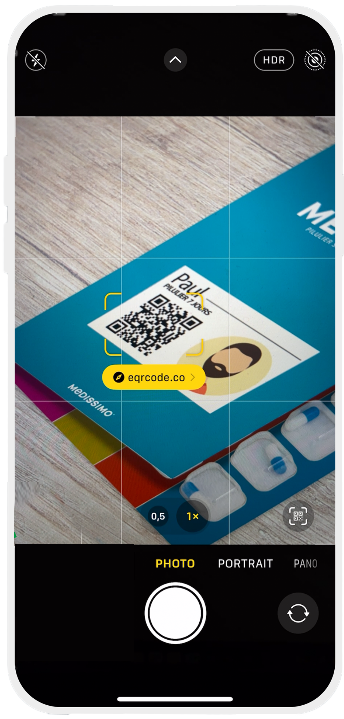
Catherine is reassured and has asked me to scan the Medipac QR code each time I visit to confirm that Madeleine has taken her medication.

In this way, Catherine and the pharmacist work together to ensure that everything runs smoothly.

pharmacist

I'm a pharmacist

I've been in business for a few years now, and I can see that many of my patients don't renew all their medications "because they still have some". 

I read in the trade press that a 2023 study shows that compliance among chronic patients in France is 32%, even though 100% of chronic patients believe they are taking their medication correctly. In this study, patients ask for more dialogue with the pharmacist and for simple, concrete and sustainable solutions.

I contacted Medissimo who suggested a web application to monitor the treatment of my chronic patients. This is useful for providing better support and developing interprofessional relations with doctors and nurses thanks to the shared compliance assessment.

Download the Medissimo Pharmacist application

medissimo nurse

I'm a nurse

I have a private practice and look after Paul, who lives alone at home. Every day, one of us adjusts his insulin doses. But Paul also suffers from heart failure. And even though Paul retains a certain degree of autonomy, we have to prepare his medication in pillboxes every week.

Her treatment requires constant monitoring, regular adjustments and excellent compliance. His pharmacist suggested a mobile application for this purpose. No more wasting time chasing prescriptions or picking up a missing box at the pharmacy, I can now exchange information quickly with him.

But above all, in just a few clicks, I can enter Paul's treatment data and edit his compliance assessment and I share it with the pharmacist and the doctor to review his treatment.

It's very useful for the quality of my care and my relations with doctors.

doctor

I'm a general practitioner and I have a lot of chronic patients undergoing heavy treatment.

I heard on the radio that a recent study shows that in France, 100% of chronic patients over 60 think they are compliant, whereas only 32% are. How can I help my patients to be more compliant with their prescriptions?

In this study, patients ask for more dialogue with their healthcare professionals, and for simple, concrete and sustainable solutions.

I spoke to pharmacists about it, and they told me that Medissimo offers simple solutions to suit different patient profiles.

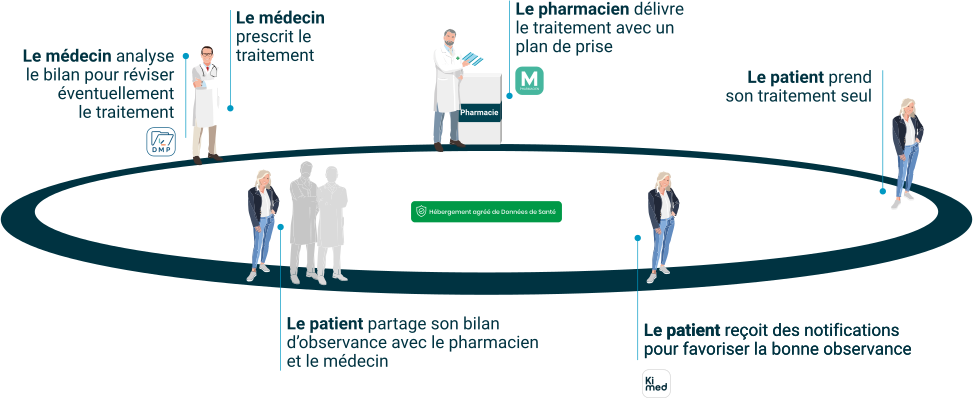
For my patients who forget to take their medication, I recommend the Kimed application connected to the pharmacy, which enables them to receive tailored notifications and generates a compliance report in the DMP, which is very useful for monitoring treatment.

For those who take a lot of medication, I recommend the Medipac® pillboxes pillboxes, prepared by the pharmacist to simplify dosing and avoid oversights, errors or contamination. People who use them have a 98% success rate. The pill dispenser's QR code can be used to record compliance and generate a compliance report in the DMP.

I find it very reassuring to share the shared compliance assessment Medissimo to review my patients' treatments.

Medissimo

This pharmacy is a Medissimo partner.

Together, we'll choose the solution that's right for you.

Have I taken my medication correctly?

Did you forget to take your medication this morning? *
Have you run out of medication since your last visit? *
Have you ever been late taking your medication? *
Have you ever stopped taking your medication because some days you feel your memory is failing you? *
Have you ever stopped taking your medication because some days you feel it's doing you more harm than good? *
Do you think you have too many tablets to take? *
0.00

Contact us

Your name *
Your company *
Your e-mail address *
Your phone *
Your message *
standard

Standard carts for MONO28 pillboxes®MEDIPAC® and MEDIPAC® PLUS

Recommended when organizing shared medication baskets (sachets, liquids, etc.)

Patients Mono28 Medipac Medipac plus
M2 25 64 24
M3 45 96 48
M4 65 128 72
Book #26780

Tray carts for MONOPLUS pillboxes® or MULTIPLUS®

Recommended for organizations with no drug storage area (all drugs in the cart for 7 days)

For 14 patients
For 28 patients

Rack carts for MONOPLUS pill dispensers®

Recommended for use with nominative lockers (dose and non-dose drugs together)

Patients Monoplus for 1 or 2 days Dose sachet for 7 days
M2 36 48
M3 48 72
M4 60 96

Request a partner quote

Name *
First name *
Email *
Phone *
Pharmacy *
medipac

The Medipac solution to simplify medication administration

The Medipac solution offers you the safety and convenience of a pharmacy-prepared, ready-to-use treatment. This solution helps you take your medication properly, which in turn helps your doctor adjust your treatment for better long-term health results. With this solution, you'll improve your compliance to protect your health.

The Medipac solution includes a secure pill dispenser connected to the pharmacy application by a QR code. The solution can integrate an application for caregivers. The data is fed into a compliance report for discussion with the pharmacist and review of treatment with the doctor. Use is free of charge.

semi-autonomous patient

The Kimed solution to protect yourself from forgetting to take your medication

The Kimed solution helps you to take your medication properly, which in turn enables your doctor to adjust your treatment for better long-term health results. With this solution, you'll improve your compliance to protect your quality of life.

The Kimed solution connects a patient application to a pharmacy application. The patient receives notifications to prevent forgetfulness and provide information on compliance, side effects and additional medication taken. The data is fed into a compliance report, which can be discussed with the pharmacist and the treatment reviewed with the doctor. Use is free of charge.

autonomous patient

Monoplus

This detachable pill dispenser allows you to repackage medications by dose, but separately, for one week. Ideal for storage in nominative compartments.

Documentation

MULTIPLUS®. 7 days treatment per dose

MULTIPLUS® packs all your medications in a single dose for one week. The MULTIPLUS® pill dispenser is useful for institutional use when the original blister pack needs to be preserved, and the individual drugs do not need to be isolated from each other.

Mono28

This non-detachable pill dispenser allows you to repackage medications by time of use, for one month. Ideal for frequent medication changes.

Documentation

MEDIPAC PLUS® The largest

MEDIPAC PLUS® is a pill dispenser with deep compartments. It enables the preparation of medicines while retaining the pharmaceutical laboratory's unit packaging. The MEDIPAC®PLUS plus pill dispenser is ideal for patients taking bagged medication.
Documentation

MEDIPAC® Simple as a paperback

Acid blue, MEDIPAC® can be seen from afar and slipped in anywhere to keep your patients' medicines tidy.
Documentation

MEDIPAC BOX® Its strength lies in its unobtrusiveness

The box contains a week's worth of pre-detached and non-pill doses, plus the prescription.
Documentation

Compliance assessment

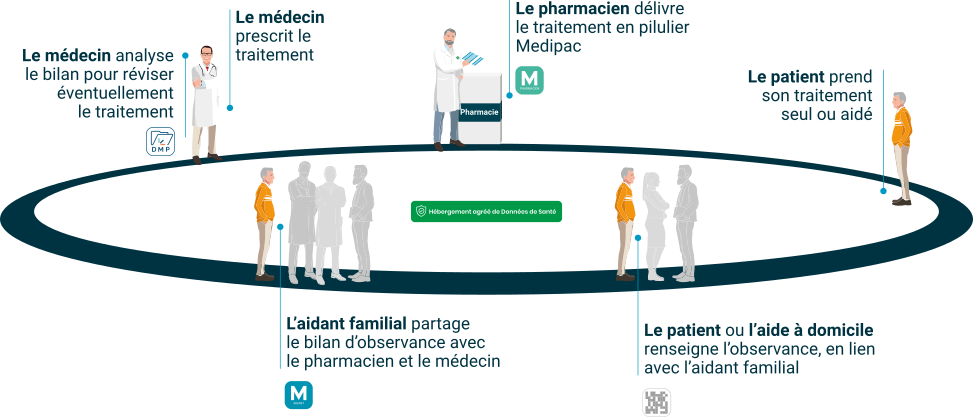
The compliance report is a summary table of medication taken, enabling treatments to be re-evaluated from the Pharmacist App and the Establishment App.

The assessment is available for each patient on the nursing and pharmacy applications.

The assessment provides a global and detailed view of compliance, and helps to better understand the reasons for non-administration at any given time. The physician's analysis of the assessment enables him/her to take action to encourage proper use of the medication.

Assessment of proper use

The "bilan de bon usage" is a set of summary tables used to identify at-risk patients and drugs from the Medissimo Pharmacien app.

The balance sheet is available to the establishment on the pharmacy application.

The assessment provides an overall view of the risks associated with medication at any given time. The physician's analysis of the assessment enables him/her to take action to promote the proper use of medication.

The MEDISSIMO platform offers a secure, traceable treatment service for patients at home and in residential care, including pillboxing of medicines in the pharmacy and treatment monitoring in cooperation with healthcare professionals and their families.

The platform brings together the pharmacist, who delivers the treatment with full traceability, and the patient or his or her homecare assistant, who fills in the dosages from the MEDIPAC® pillbox prepared by a healthcare professional, and the nurse, who monitors the treatment in liaison with the pharmacist and the family, and informs the doctor in the event of a medication risk.

In line with the public health priority defined in the national health strategy, the pharmacist - nurse - attending physician triad is at the heart of the platform designed by MEDISSIMO, with the aim of promoting the proper use of medicines.

Tutorial request

SSIAD agreement request form

The MEDIPAC® IDEL application can be downloaded from your smartphone