
"Medicines are not ordinary products, and we shouldn't take them lightly. .." warns the ANSM (Agence Nationale de Sécurité du Médicament), which this year launched a major national awareness campaign on this major public health issue.
This dreaded phenomenon has a name: iatrogeny. It refers to the undesirable consequences of an inappropriate healthcare act, whether the responsibility of healthcare professionals or the patient.
In its most serious forms, iatrogenia kills: no fewer than 10,000 deaths a year in France are attributable to it. What's more, over 130,000 hospitalizations could be avoided every year by better monitoring of drug use.
Still too many accidents are the result of poor treatment follow-up. Inappropriate self-medication, dosage errors and consumption without medical indication can have dramatic consequences, particularly for chronically elderly patients with multiple medications.
Health is priceless, but it does have a cost. A human, medical and financial cost that should encourage patients and all those involved in their care to take the full measure of what is at stake.
Public authorities, Assurance Maladie and complementary health insurance organizations, doctors, pharmacists, healthcare professionals, homecare workers and family carers all have a role to play in ensuring the correct use of medicines.
What are the main risk factors to watch out for?
Among the most common risk factors are, of course, polypharmacy (taking more than 4 drugs a day on a regular basis), age (very young or very old people are more vulnerable), and, of course, state of health, with a notable risk for patients with conditions impairing their judgment.
Pami elderly populations, according to a recent study, " (the) chronic poly-medicated patients feel that beyond̀ 7 medications a day, it becomes too much for them ". This finding creates a risk of "selection" among the treatments to be taken by this population.
The study's other fearsome findings are that patients themselves seem to minimize the impact of these little arrangements, and even claim to be taking their medication properly, when the reality is quite different.
This lack of compliance directly jeopardizes their health.
What are the solutions and what room for manoeuvre do those involved in the care chain have?
Committed to improving the health of their patients on a daily basis, healthcare professionals are also aware that their civil and criminal liability can be directly incurred in the event of failure to comply. Any error in dosage or dosage, or even a simple oversight with serious consequences, can potentially - and sometimes unfairly - be held against them.
One of the keys to improving compliance is undoubtedly the ability of healthcare professionals to work together more effectively. Thanks to shared information and a genuine patient compliance pathway, everyone should be able to ensure the correct use of medication. Another avenue worth exploring probably lies in the relationship of trust and dialogue that develops between patient and pharmacist. "As a local healthcare player, the pharmacist has a key role to play, in cooperation with other healthcare professionals, in proposing simple, practical and sustainable solutions to prevent drug-related accidents.
In any case, the subject of compliance remains a sensitive one, all the more so as the chronic patient's close emotional entourage often also feels invested with this monitoring mission.
What is the role of the patient's entourage?
When it comes to caring for frail elderly patients living at home, family carers often play a crucial role, whether in helping with simple daily tasks or in helping their loved ones take their medication correctly.
Whether or not the patient benefits from home help, caregivers often find themselves at a loss and unable to cope with the care of their close relative on their own.
In this context, among other legitimate concerns, the question of taking medication correctly can become a real source of anxiety, adding to an already difficult mental burden.
Public authorities have a key role to play in effectively combating drug misuse, whether it's a question of support for caregivers, prevention, or strengthening local healthcare cooperation.
What can be done to meet this major public health challenge?
In addition to the direct consequences on patients' health, the phenomenon raises societal issues, and puts a definite strain on our healthcare system.
Hospitalizations, the costs they entail, and the increase in medical visits linked to the misuse of medication, represent a risk of "overload" for our healthcare system, which is already under strain in our "aging" society.
From an economic point of view, medication errors entail significant costs for the healthcare system. According to a study published on the John Libbey Eurotext website: "Medication-related iatrogeny (...) is implicated in 6.5% of hospital admissions, 9% of hospital stays and 15% of admissions to intensive care (...) the median length of stay was four days in intensive care followed by nine days in another department for an average cost per patient of €12,315."
Combating the misuse of medicines is a complex issue, affecting patients' individual health and quality of life, caregivers' right to respite and relief, and the economic and social equilibrium of our entire healthcare system. Public authorities must play a greater role in prevention and in promoting responsible, safe and effective medication practices. Juggling with prescriptions can be a dangerous business!
How can we promote the proper use of medicines by chronically elderly patients with partial or total loss of autonomy?
Regular monitoring is essential to prevent the risks associated with non-compliance. Even with the best will in the world, beyond a certain age - 80 according to some specialists - there are real problems of visual recognition of medication.
The number of medications to be taken, the frequency with which they need to be taken in the course of a day, and the degree of dosing precision required, can quickly become complex for frail, elderly patients.
In this respect, patient-caregiver dialogue and cooperation between healthcare professionals remain essential! Practical solutions also exist: pillboxes, for example, are simple tools which, when used correctly, enable effective monitoring of medication intake.
However, it remains difficult for the carer or caregiver to ensure that the medication is taken when the patient is alone, isolated, or even without social ties. And this is where the role of the pharmacist can be decisive, particularly in small towns: " Pharmacist-prepared pillboxes are a promising solution for strengthening dialogue and local care".
" From the age of 80, or even earlier if the situation requires it, safety should require pharmacists to prepare a weekly pillbox ".
Together, public authorities, healthcare professionals, healthcare companies and social protection players, let's mobilize and take action to raise awareness among our seniors and all our fellow citizens of the need to make better use of medicines.
Medissimo, a company resolutely committed to the proper use of medication, offers pillbox solutions combined with digital monitoring devices that enable patients, their families, pharmacists and caregivers to monitor the patient's medication intake in real time and with complete peace of mind.
1 According to AMELI
2Patients whose daily consumption is greater than or equal to 5 medications
3According to Dr. Vétel: "problems with memory, eyesight and lack of dexterity are the main factors in non-compliance", quoted in Revue Notre Temps, "Zut, j'ai oublié de prendre mes médicaments", Nov. 2023
4 Exclusive OPINION WAY - MEDISSIMO - NOTRE TEMPSsurvey of a representative panel of people over 60 living at home in mainland France, taking at least five different medications a day, Revue Notre Temps, Nov. 2023
5The survey in 4 highlights the extent of the gap between declared and actual compliance
6A caregiver is a person who lives and acts in the immediate vicinity of a person who is ill, suffering or losing their autonomy. It is not a legal status in its own right.
7Caroline Blochet, doctor of pharmacy, op.cit., Revue Notre Temps, nov.2023
8 Specialized scientific publicationssite : Iatrogénie médicamenteuse responsable d'hospitalisation en réanimation : étude descriptive dans un center hospitalier.
9Caroline Blochet, doctor of pharmacy, op.cit., Revue Notre Temps, nov.2023
10 Dr Vétel, op.cit., Revue Notre Temps, nov. 2023



Recommended when organizing shared medication baskets (sachets, liquids, etc.)
| Patients | Mono28 | Medipac | Medipac plus |
| M2 | 25 | 64 | 24 |
| M3 | 45 | 96 | 48 |
| M4 | 65 | 128 | 72 |

Recommended for organizations with no drug storage area (all drugs in the cart for 7 days)
| For 14 patients |
| For 28 patients |

Recommended for use with nominative lockers (dose and non-dose drugs together)
| Patients | Monoplus for 1 or 2 days | Dose sachet for 7 days |
| M2 | 36 | 48 |
| M3 | 48 | 72 |
| M4 | 60 | 96 |

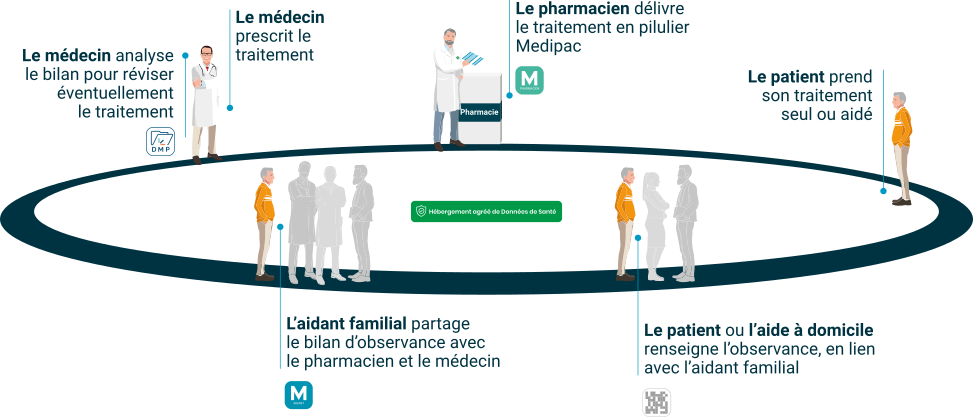
The Medipac solution offers you the safety and convenience of a pharmacy-prepared, ready-to-use treatment. This solution helps you take your medication properly, which in turn helps your doctor adjust your treatment for better long-term health results. With this solution, you'll improve your compliance to protect your health.
The Medipac solution includes a secure pill dispenser connected to the pharmacy application by a QR code. The solution can integrate an application for caregivers. The data is fed into a compliance report for discussion with the pharmacist and review of treatment with the doctor. Use is free of charge.

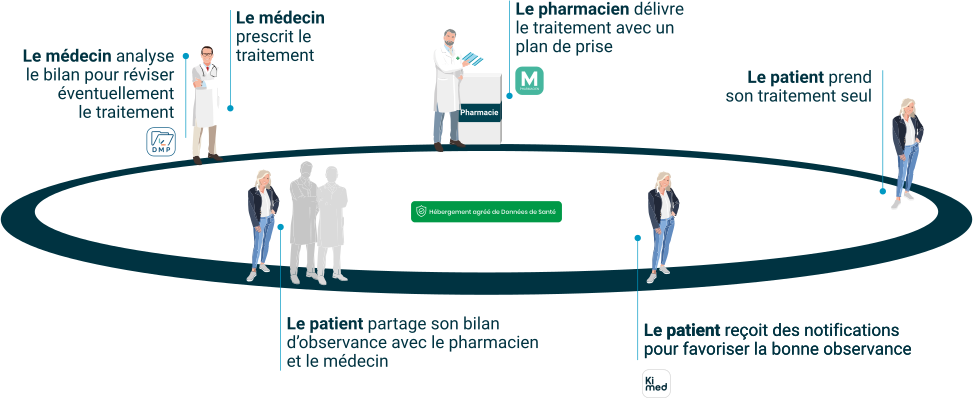
The Kimed solution helps you to take your medication properly, which in turn enables your doctor to adjust your treatment for better long-term health results. With this solution, you'll improve your compliance to protect your quality of life.
The Kimed solution connects a patient application to a pharmacy application. The patient receives notifications to prevent forgetfulness and provide information on compliance, side effects and additional medication taken. The data is fed into a compliance report, which can be discussed with the pharmacist and the treatment reviewed with the doctor. Use is free of charge.
This detachable pill dispenser allows you to repackage medications by dose, but separately, for one week. Ideal for storage in nominative compartments.
MULTIPLUS® packs all your medications in a single dose for one week. The MULTIPLUS® pill dispenser is useful for institutional use when the original blister pack needs to be preserved, and the individual drugs do not need to be isolated from each other.
This non-detachable pill dispenser allows you to repackage medications by time of use, for one month. Ideal for frequent medication changes.
The compliance report is a summary table of medication taken, enabling treatments to be re-evaluated from the Pharmacist App and the Establishment App.
The assessment is available for each patient on the nursing and pharmacy applications.
The assessment provides a global and detailed view of compliance, and helps to better understand the reasons for non-administration at any given time. The physician's analysis of the assessment enables him/her to take action to encourage proper use of the medication.
The "bilan de bon usage" is a set of summary tables used to identify at-risk patients and drugs from the Medissimo Pharmacien app.
The balance sheet is available to the establishment on the pharmacy application.
The assessment provides an overall view of the risks associated with medication at any given time. The physician's analysis of the assessment enables him/her to take action to promote the proper use of medication.
The MEDISSIMO platform offers a secure, traceable treatment service for patients at home and in residential care, including pillboxing of medicines in the pharmacy and treatment monitoring in cooperation with healthcare professionals and their families.
The platform brings together the pharmacist, who delivers the treatment with full traceability, and the patient or his or her homecare assistant, who fills in the dosages from the MEDIPAC® pillbox prepared by a healthcare professional, and the nurse, who monitors the treatment in liaison with the pharmacist and the family, and informs the doctor in the event of a medication risk.
In line with the public health priority defined in the national health strategy, the pharmacist - nurse - attending physician triad is at the heart of the platform designed by MEDISSIMO, with the aim of promoting the proper use of medicines.
